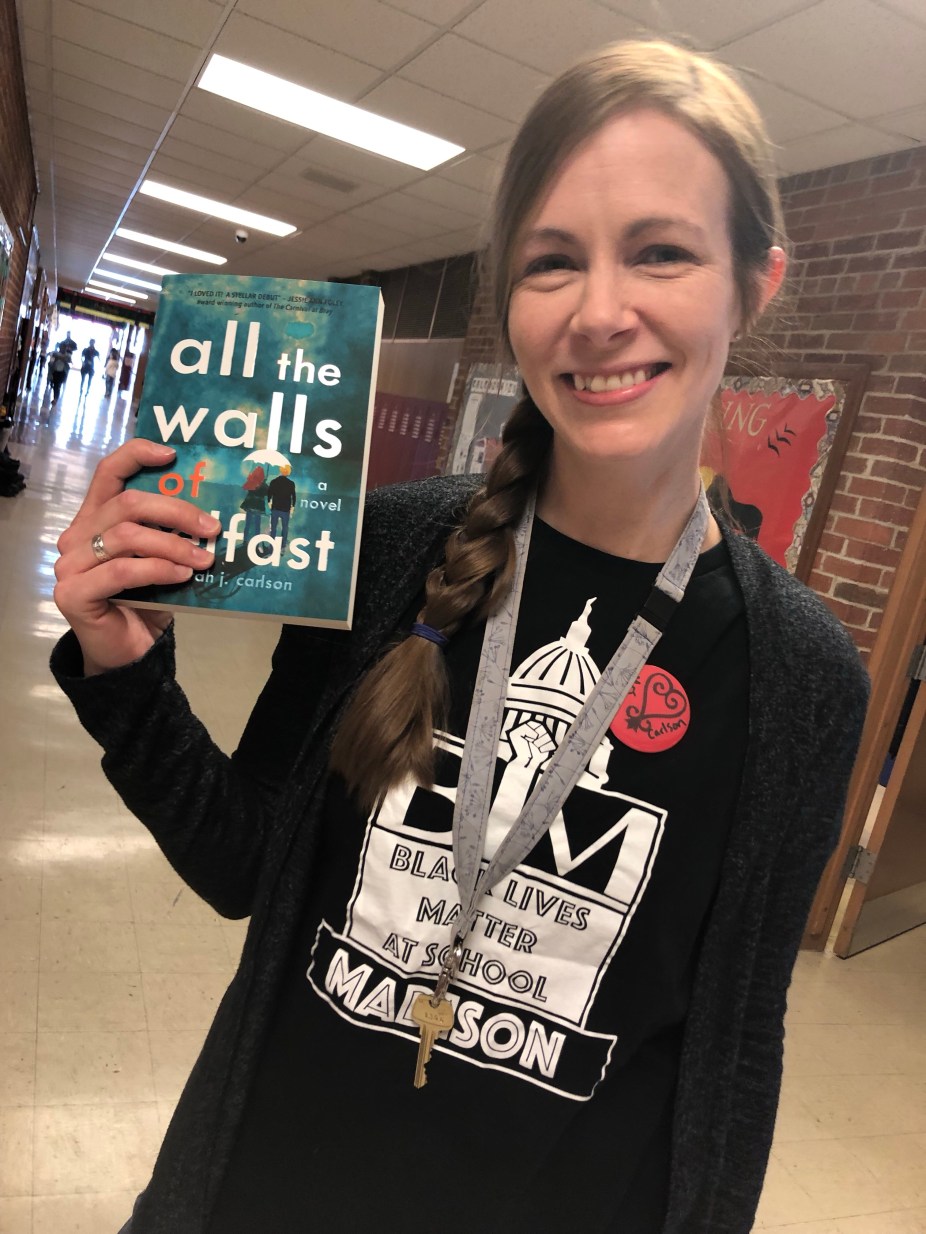


It’s a real, actual book. Still don’t totally believe it 😊😊😊 For the rest of the United States and Canada, All the Walls of Belfast is out March 12th, 2019. 🧡💚🧡💚
It’s a real, actual book. Still don’t totally believe it 😊😊😊 For the rest of the United States and Canada, All the Walls of Belfast is out March 12th, 2019. 🧡💚🧡💚
After five years of work, I’m so excited to officially reveal the cover of my debut novel, ALL THE WALLS OF BELFAST, to the world!
About All the Walls of Belfast
The Carnival at Bray meets West Side Story in Sarah Carlson’s powerful YA debut; set in post-conflict Belfast (Northern Ireland), alternating between two teenagers, both trying to understand their past and preserve their future. Seventeen-year-olds, Fiona and Danny must choose between their dreams and the people they aspire to be.
Fiona and Danny were born in the same hospital. Fiona’s mom fled with her to the United States when she was two, but, fourteen years after the Troubles ended, a forty-foot-tall peace wall still separates her dad’s Catholic neighborhood from Danny’s Protestant neighborhood.
After chance brings Fiona and Danny together, their love of the band Fading Stars, big dreams, and desire to run away from their families unites them. Danny and Fiona must help one another overcome the burden of their parents’ pasts. But one ugly truth might shatter what they have…
What input did you have on the cover and what symbolism does it incorporate?
Most authors spend months or even years imagining what their cover might look like, but when it’s finally time to design it . . . ah! When it was officially time to design mine, Turner’s creative director asked my input on general cover ideas. I tried imagining ALL THE WALLS OF BELFAST on a bookshelf, asking myself what might draw a YA reader in. I don’t feel the title sounds explicitly YA, so the image had to clearly convey that, which was why I wanted Danny and Fiona holding hands. The peace wall separating their neighborhoods is, in some ways, a character in and of itself, so I wanted at least a hint of a wall in the background.
The creative director then sent me three cover comps from the cover artist. Cover comps are just general, vague ideas for covers. I picked the one I liked best and specified how I wanted the characters to look and dress. In the end, I love Fiona and Danny being somewhat indistinct on the cover because it allows the reader to fill in the blanks as they read. The color choices for the background capture the frequent rain of Northern Ireland and a certain sense of foreboding, but the umbrella Danny and Fiona share suggests hope and shelter they may find in one another.
I also wanted to subtly incorporate the colors of the Irish flag – orange and white in the title letters and green in Fiona’s coat. The tricolor has symbolism rooted deep in the island’s complex history, which I don’t think many Americans realize. Very simply put: green represents Roman Catholics of Ireland, orange represents the minority Protestants, and white represents the hope for a lasting peace and union between people of different traditions in an independent Irish nation. ALL THE WALLS OF BELFAST explores the lasting impact of the sectarian violence of the Troubles, which has its roots deep in that same legacy in Irish history, on the lives of two teens long after it officially ended.
What inspired you to write All the Walls of Belfast?
ALL THE WALLS OF BELFAST was inspired by a trip to Northern Ireland I took back in 2011. Prior to that, I had vague memories of hearing about the Troubles in middle school but forgot about it. On this trip, I was shocked to find that, while the vast majority of Northern Ireland has moved on, some working class Protestant Loyalist and Catholic Republican communities in Belfast were (and still are) separated by massive peace walls and many children from these communities may go their entire childhood without talking to someone from the other religion. I found a story to tell.
How long was your writing journey for All the Walls of Belfast?
It took about five years, largely because of the research that went into it: taking three trips to Belfast and visiting all setting locations and exploring history and different perspectives, recruiting Belfast readers, studying the Troubles and the long history leading up to them, daily tracking of current events in Belfast and Northern Ireland, researching both British English and specifically Northern Irish dialect through mediums such as novels/movies/shows, Google Maps streetviewing everything, among other things. It also took some time (and many re-writes) to find the heart of Fiona’s story, as well as her voice. Which is kind of ironic, since she’s the basically American character. And then there were the many, many re-writes.
Who will All the Walls of Belfast appeal to?
Readers who enjoy being challenged by complex themes like forgiveness for egregious past mistakes, rising above the burden of the past to forge a new future for yourself, and challenging the notion of “other” ingrained in you by adults. And anyone who might enjoy a dash of star-crossed romance.

ALL THE WALLS OF BELFAST will be released by Turner Publishing Company on March 12th, 2019. It is now available for preorder at:
Also, in honor of my cover reveal, YA Books Central is hosting a giveaway for a signed ARC and some book swag.

For me, where and how to begin my novels has pretty much always been the hardest part to get right. For ALL THE WALLS OF BELFAST, I (no joke!!) wrote probably at least twenty different first chapters, the start points ranging from abus ride home from finals to a funeral to a plane landing in Dublin. And a few other places in between. So, yeah….
If your first chapter, first page, first paragraph, maybe even first line, can’t draw in readers, the rest of your book doesn’t matter. And there are so many jobs it has to get done, including establishing genre, introducing us to central characters (but not too many), showing us the world, and introducing the central conflict.
So, how can we make our first pages un-put-down-able? Here’s a few tips I learned based on my experience reading submissions for #WriteMentor.
So those are a few tips on first pages. And, absolutely yes, we need to be hyper-focused on our first pages, but those only get you in the door with readers. The rest of your novel needs to be just as good.
Here are few more resources:
How to Write the Perfect First Page
Four Approaches to the First Chapter of Your Novel
25 Things to Know About Writing the First Chapter of Your Novel
Happy writing!
Oh, the synopsis. The beastly synopsis. And it seems like everyone wants something different. One page or two?

Just like the dreaded query letter, there are many resources out there with explicit guidelines on how to write it (I put the links at the end), so I won’t rehash it here. I’m going to give you my two cents, based on my own experiences, research, and reading many through #WriteMentor, for whatever it’s worth.
The query letter is all business. The synopsis is similarly not glamorous. It’s one and only job is to show the entire story arc, boiled down to its essence, so an agent or editor sees characters and the plot and, very important, what makes your story unique. Just tell the story, and show us through the action and plot why we should care about your characters and why the story needs to be told.
For me, like the query, it’s always been a painful, yet incredibly useful exercise. Writing the synopsis forces me to find and succinctly show the very heart and soul of my story. Sometimes having to boil your story down to a synopsis reveals plot holes or contrived plot devices. It forces you to lay out what’s at stake and how your MC’s choices are driving the story (or not…eek).
The synopsis is really just a summary of who and what changes in the book, from beginning to end. It’s job: to show the characters and their actions that drive the plot forward in reaction to the antagonist’s actions, and how it impacts them physically and emotionally and changes their central relationships.
The biggest thing is to focus on your main character’s AGENCY. Show the reader how their choices (both good and bad) in response to the antagonist are propelling the plot forward all the way to the inevitable end. Every line in the synopsis should be causally connected and building on the last, showing the plot thickening due to the character’s choices. And it must show the entire narrative arc, including the ending.
We want to connect to your characters, to care about them, and this is done in part through building a strong sense of internal and external conflict. If we can’t feel the tension in the synopsis, what does that say about the book? Here’s a great bit of advice from Jane Friedman, who knows the art of everything writing a thousand times better than me:
“Incident (Story Advancement) + Reaction (Feelings/Emotion) = Decision (Story Advancement)”
Do this over and over again for each obstacle the main character faces.
You can read the rest of her advice on synopsis writing here.
You don’t need to name every character or detail every subplot, especially if you have multiple POVs or complex things going on, or it becomes confusing, convoluted, and incoherent. Show us the main character’s choices in response to the obstacles being thrown out there by the antagonist, the consequences of those choices (physical, emotional, relational), which lead to the next choice they have to make. Show us how the choices change the relationships between important characters, as this is at the heart of tension, and internal and external conflict. Show us the evolution of the important relationships as the plot progresses.
Each sentence should show the internal and external plot thickening due to the character’s choices and agency.
A few more tips:
Just like the query letter, have members of your writing tribe tear apart your synopsis. Their fresh eyes will see things yours don’t. Have people unfamiliar with your story read it as well, to see if you synopsis makes sense and flows with no context. And critique others’ synopses, as this will help you learn what works and doesn’t, and hopefully apply it to your own.
Here’s a few more resources:
Learn How to Write a Synopsis Like a Pro
How to Write a 1 Page Synopsis
The Anatomy of a Short Synopsis
On my end, All the Walls of Belfast is now on Good Reads! Check it out, and if you’re interested, add it to your “Want to Read” list. Cover reveal with teaser trailer coming SOON!
Next week, the topic will be those critical first pages. Happy writing!

Turner Publishing has now officially put my debut YA novel ALL THE WALLS OF BELFAST up on Goodreads. Here’s a quick blurb: Pitched as THE CARNIVAL AT BRAY meets West Side Story, ALL THE WALLS OF BELFAST follows two teens trying to understand their past and preserve their future in post-conflict Belfast–a Wisconsinite who learns she has a father and brothers in Belfast and a boy trying to escape an abusive home to pave his own way.
Check out the official Goodreads book page here! If you’re intrigued, please add it to your “Want to Read” list. Wow, now it’s all really starting to feel real.
And I’m excited to announce that VERY SOON will be the cover reveal. I’m totally in love with it and can’t wait for it to be out in the world.
To stay up-to-date on all things ALL THE WALLS, and for stuff about the craft of writing and my random pictures, follow my blog, sign up for my newsletter, or follow me on Twitter, Instagram, or Facebook.
 Sarah J. Carlson